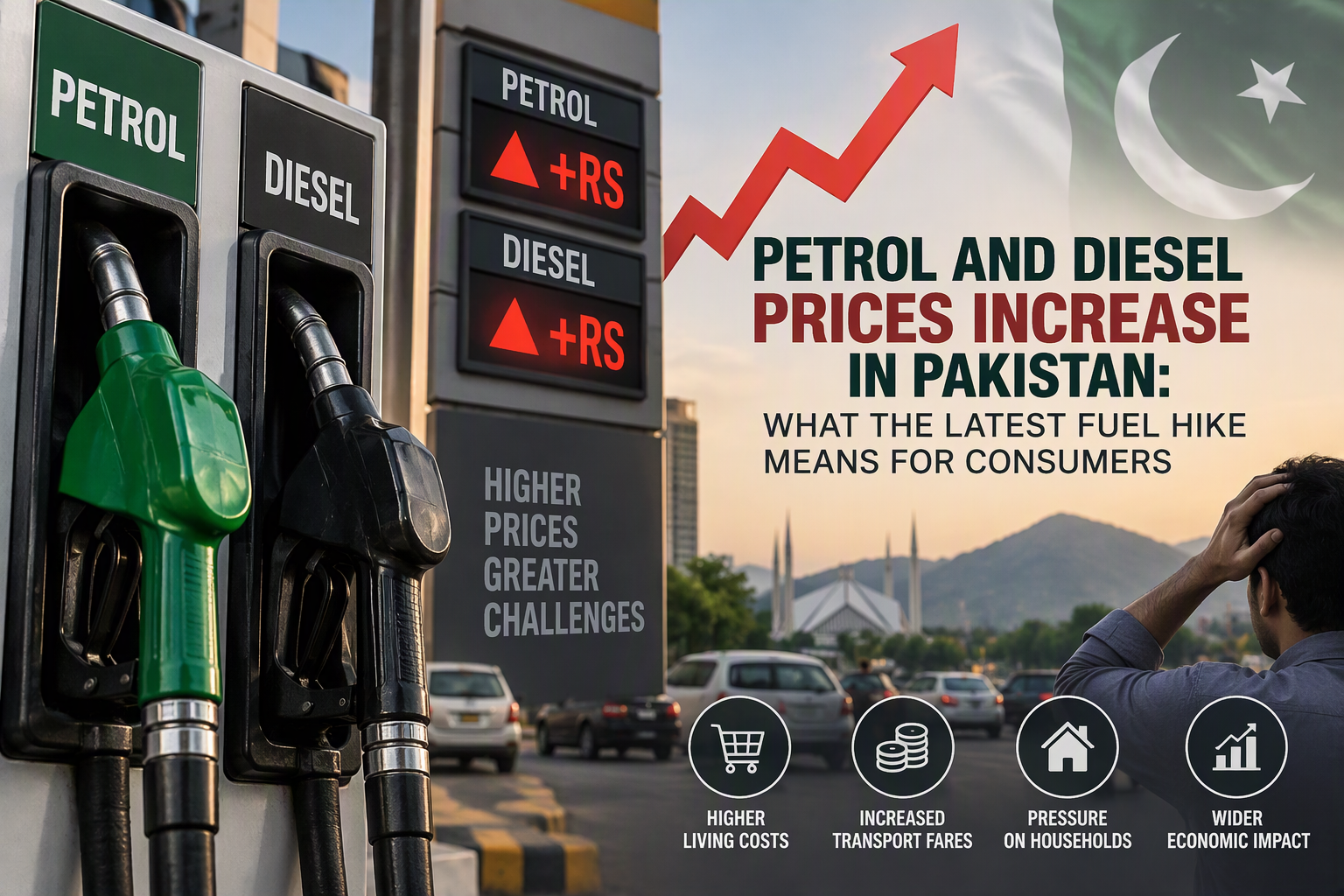
Petrol and Diesel Prices Increase in Pakistan
Fuel prices in Pakistan have once again moved upward, adding to the financial pressure already being felt by households, motorists, businesses and transport operators across the country.
The federal government has increased the price of petrol by Rs0.88 per litre, while the price of high-speed diesel (HSD) has gone up by Rs0.53 per litre. The latest revision takes effect from October 21, according to a notification issued by the Petroleum Division.
With the new adjustment, petrol will now be available at Rs382.02 per litre, while high-speed diesel will cost Rs389.80 per litre.
Although the latest increase may appear relatively small when compared with some of the much sharper fuel price movements witnessed earlier in the year, even a minor increase can have a noticeable impact on household budgets in Pakistan. Petrol and diesel are not simply fuels for private vehicles. They are closely connected to transportation, agriculture, electricity generation, logistics, manufacturing and the prices of everyday goods.
The latest increase also comes at a time when international oil markets remain sensitive to geopolitical developments, particularly the continuing tensions in the Middle East. The government has already taken several steps aimed at conserving fuel and reducing unnecessary consumption as global oil prices remain volatile.
New Petrol and Diesel Prices in Pakistan
Under the latest revision, the price of petrol has increased by 88 paisas per litre.
This means consumers will now pay:
- Petrol: Rs382.02 per litre
- High-Speed Diesel: Rs389.80 per litre
The petrol price was previously Rs381.14 per litre, while high-speed diesel was selling at Rs389.27 per litre.
The revised rates will remain applicable from October 21 under the latest Petroleum Division notification.
For many consumers, the most important question is not necessarily how much the price has increased by itself, but what that increase means for their monthly expenses.
For someone who regularly uses a car or motorcycle, a few paisas or less than a rupee per litre may not appear significant at first. However, when fuel prices remain high over an extended period, even small increases can add to transportation costs.
The impact becomes considerably larger for people who drive long distances every day, operate commercial vehicles or depend on fuel for their businesses.
Why Fuel Prices Matter So Much in Pakistan
Fuel prices have a much wider impact on the economy than the amount displayed at a petrol station might suggest.
Petrol is primarily associated with cars, motorcycles and other light vehicles, while diesel is widely used by buses, trucks, tractors, heavy machinery and other commercial equipment.
When diesel becomes more expensive, transportation companies may face higher operating costs. Truck operators, for example, need diesel to move goods from one part of the country to another. If their fuel expenses increase, they may eventually adjust their transportation charges.
Those additional costs can then make their way through the supply chain.
A product manufactured in one city may need to be transported to a warehouse, then to a distributor and eventually to a retailer. Each stage can involve fuel consumption. As transportation costs rise, businesses may face greater pressure to increase prices or accept lower profit margins.
This is why fuel price changes are closely watched by consumers and businesses alike.
Fuel prices are not the only major market indicator that Pakistani consumers are watching closely. Changes in the cost of essential commodities and precious metals can also influence household budgets and investment decisions. For readers tracking another important market, you can also check our latest gold price in Pakistan update, including recent rates and market trends.
Government Continues to Collect Heavy Taxes on Fuel
Another important aspect of the latest fuel price adjustment is the significant amount of taxes and duties included in the retail prices.
According to the information provided by the Petroleum Division, the government continues to collect Rs114 per litre in taxes and duties on petrol.
For diesel, the amount stands at approximately Rs100 per litre.
This means that a substantial portion of what consumers pay at the pump consists of government taxes and duties.
Fuel taxation is an important source of revenue for the government, particularly at a time when Pakistan faces significant fiscal pressures. However, high fuel taxes can also increase the financial burden on consumers.
The government therefore faces a difficult balancing act.
On one side, it needs revenue to fund public spending and meet its financial obligations. On the other, higher fuel costs can increase inflationary pressure and make transportation more expensive for ordinary citizens.
The issue becomes particularly sensitive when international oil prices are already elevated.
Petrol and Diesel Have Experienced Much Bigger Swings This Year
The latest increase is relatively modest when compared with the dramatic changes seen in fuel prices earlier in the year.
High-speed diesel had reached a much higher level of Rs520.35 per litre on April 3.
That figure represented a major increase from the levels seen before the sharp escalation in international tensions.
According to the supplied information, diesel had been priced at around Rs281 per litre before beginning its steep upward movement following the outbreak of the US-Iran conflict on February 28.
The increase from Rs281 to more than Rs520 represented a major shock for consumers and businesses.
The difference was particularly significant for industries and sectors that depend heavily on diesel.
Agriculture is one example.
Farmers use diesel-powered machinery and equipment for a range of activities, including operating tractors and irrigation equipment. A substantial increase in diesel prices can therefore affect agricultural production costs.
Transportation is another major area of concern.
Heavy vehicles generally depend on diesel, meaning higher diesel prices can translate into higher costs for freight and public transportation.
Petrol Also Reached a Record High Earlier
Petrol experienced a similar surge.
The price of petrol reached Rs458.41 per litre on April 3, after starting its upward movement from around Rs266 per litre during the first week of March.
That represents a dramatic increase within a relatively short period.
For ordinary motorists, such a jump can have an immediate effect on household finances.
Consider a driver who uses 50 litres of petrol each month. At Rs266 per litre, that monthly fuel bill would have been around Rs13,300.
At Rs458.41 per litre, the same 50 litres would cost approximately Rs22,920.
That is a difference of more than Rs9,600 for the same quantity of fuel.
This example illustrates why fuel prices are such an important issue for Pakistani households. People do not necessarily have the option of reducing their fuel consumption significantly, particularly when they depend on private transport to travel to work, take children to school or conduct business.
Global Oil Markets Continue to Influence Pakistan
Pakistan does not produce enough crude oil domestically to meet its overall energy requirements. As a result, international oil market conditions play a significant role in determining domestic fuel prices.
When global crude oil prices rise, the cost of importing petroleum products can increase. Currency movements can add another layer of pressure.
If the Pakistani rupee weakens against the US dollar at the same time that international oil prices rise, the domestic impact can become even more pronounced.
This is because oil is traded internationally in dollars.
Geopolitical developments can also cause sudden changes in global energy markets.
Conflicts involving major oil-producing countries or regions can create concerns about supply disruptions. Even when actual supplies are not immediately affected, markets can react to the possibility of future disruptions.
The Middle East remains particularly important because of its role in global energy production and transportation.
As tensions in the region increase, governments and consumers around the world closely monitor developments in oil markets.
Pakistan is no exception.
Middle East Conflict Has Added to Fuel Concerns
The latest fuel price revision comes against the backdrop of continuing tensions in the Middle East.
The government has already responded by introducing measures aimed at reducing fuel consumption.
Among these measures is an instruction requiring markets to close by 9pm.
The government has also reduced fuel allocations for official vehicles by 50 per cent for a period of three months.
Such measures are designed to conserve fuel and reduce unnecessary consumption at a time when global oil prices are placing additional pressure on the economy.
Early closing of markets can potentially reduce electricity and fuel consumption associated with commercial activity during late evening hours. Meanwhile, reducing official vehicle fuel allocations is intended to limit government-sector consumption.
However, these policies can also affect businesses and consumers.
For shopkeepers, earlier closing hours can reduce the amount of time available to serve customers. For consumers, it can mean adjusting shopping schedules.
The effectiveness of such measures ultimately depends on how consistently they are implemented and whether they are accompanied by broader energy and economic policies.
Relief Measures for Motorcycle and Small-Car Users
The government has also announced measures intended to provide relief to some of the people most affected by rising fuel costs.
On September 13, Prime Minister Shehbaz Sharif announced a relief initiative for users of motorcycles, rickshaws and vehicles with engines of up to 800cc.
The stated objective was to reduce the burden of rising global oil prices on lower-income and middle-income consumers.
This group is particularly important because motorcycles and small vehicles are widely used for daily commuting.
For many working people, motorcycles are not a luxury. They are an affordable means of travelling to work, running errands and supporting small businesses.
When petrol prices rise significantly, motorcycle users can still face financial difficulties even though their vehicles generally consume less fuel than larger cars.
Any relief mechanism targeting these consumers could therefore have a meaningful impact, depending on how it is implemented and how much assistance is ultimately provided.
Government Moves Toward More Frequent Fuel Price Adjustments
Another major development in Pakistan’s fuel pricing policy is the move toward more frequent adjustments.
Petroleum Minister Ali Pervaiz Malik had previously indicated on July 17 that fuel prices could be fixed on a daily basis because of fluctuations in international market prices following renewed hostilities between Iran and the United States.
A daily pricing system would represent a significant change from the more familiar system in which consumers typically wait for periodic government announcements.
The idea behind more frequent adjustments is relatively straightforward.
If international oil prices can change rapidly, a pricing mechanism that responds more quickly could allow domestic prices to reflect global market conditions more closely.
However, such a system could also make fuel prices more unpredictable for consumers.
Under a daily pricing arrangement, motorists could potentially see prices change frequently. This may make it more difficult for households and businesses to plan their monthly budgets.
For businesses that depend heavily on fuel, predictable costs are particularly important.
How Higher Petrol Prices Affect Ordinary Households
The effect of petrol prices is not the same for everyone.
A person who drives only occasionally may notice very little difference from an increase of less than one rupee per litre.
But someone who travels long distances every day may feel the impact more clearly.
For example, imagine a driver who uses 80 litres of petrol every month.
An increase of Rs0.88 per litre would add approximately Rs70.40 to that person’s monthly fuel bill.
That may not sound like a major amount by itself.
However, this calculation only represents the latest increase. The larger issue is the overall level of petrol prices.
At Rs382.02 per litre, filling a 40-litre tank would cost more than Rs15,000.
For a household with a limited monthly income, spending such an amount on fuel can represent a substantial share of its budget.
This is why consumers often pay attention not only to the size of the latest increase but also to the broader direction of fuel prices.
Diesel Prices Can Have an Even Wider Economic Impact
While petrol prices attract considerable public attention because millions of motorists use petrol-powered vehicles, diesel prices can have a broader economic effect.
Diesel is heavily used by commercial transportation.
Trucks carrying food, clothing, construction materials and other goods depend on diesel. Buses and other heavy vehicles also use diesel, as do many agricultural machines.
As a result, a rise in diesel prices can increase the cost of moving goods.
Suppose a truck operator spends thousands of rupees on diesel during a long-distance journey. Even a modest increase in the price per litre can add to the total cost of the trip.
If fuel prices remain elevated, transport companies may eventually need to revise their freight rates.
Those higher freight rates can then affect the final prices consumers see in shops and markets.
This is one reason fuel prices are often described as a key component of inflation.
Agriculture Could Also Feel the Pressure
Pakistan’s agricultural sector is another area where diesel prices matter significantly.
Farmers depend on fuel for tractors, tube wells, harvesting equipment and other machinery.
When diesel prices increase, the cost of operating this equipment can rise.
Farmers may then face higher production costs, especially when fuel increases occur alongside rising prices for fertilizers, seeds, pesticides and other agricultural inputs.
Higher production costs do not automatically mean that food prices will rise by the same amount. Many other factors influence food prices, including weather, crop yields, transportation costs, market conditions and government policies.
Nevertheless, fuel remains an important part of the agricultural cost structure.
What the Latest Increase Means for Inflation
Fuel prices and inflation are closely connected.
There is a direct effect when consumers spend more money filling their vehicles.
There is also an indirect effect because fuel is used throughout the economy.
Transportation is required to move raw materials to factories, finished products to warehouses and goods from wholesalers to retailers.
When transportation costs rise, businesses may pass some of those additional expenses on to customers.
This can increase the prices of goods and services.
The effect does not necessarily appear immediately. Businesses may initially absorb higher costs in order to maintain sales and remain competitive. But if elevated fuel prices continue, maintaining the same prices can become increasingly difficult.
For consumers already dealing with higher living costs, additional inflationary pressure can be challenging.
Why the Government Has Limited Room to Maneuver
The government faces several competing pressures when setting fuel prices.
Reducing petrol and diesel prices can provide immediate relief to consumers. However, doing so may increase the government’s financial burden, particularly if international oil prices are high.
Maintaining higher prices can protect government revenue and reduce the need for additional subsidies, but it places more pressure on households and businesses.
There is also the question of taxes.
With Rs114 per litre in taxes and duties on petrol and Rs100 per litre on diesel, changes in taxation can have a significant effect on what consumers pay.
Any decision to reduce fuel taxes could provide relief at the pump, but it could also reduce government revenue.
The challenge is therefore not simply about deciding whether fuel should become cheaper or more expensive. It is about balancing fiscal requirements, inflation, energy security and the financial wellbeing of consumers.
What Consumers Can Expect Going Forward
The future direction of fuel prices will depend heavily on international oil markets.
If global crude prices remain elevated or increase further, Pakistan could face additional pressure on domestic fuel prices.
On the other hand, if geopolitical tensions ease and international oil prices decline, consumers could potentially see relief.
Exchange-rate movements will also remain important.
Because petroleum products are linked to international prices and dollar-based transactions, fluctuations in the rupee-dollar exchange rate can affect the domestic cost of fuel.
This means that even if international oil prices remain relatively stable, currency depreciation could still create pressure on local fuel prices.
For consumers, the best approach is therefore to watch both global oil developments and domestic economic conditions.
Fuel Prices Remain a Major Concern for Pakistan
The latest increase of Rs0.88 in petrol prices and Rs0.53 in high-speed diesel prices may look small when viewed in isolation.
However, the broader context tells a more important story.
Pakistan has experienced substantial fuel price fluctuations during the year, with petrol previously reaching Rs458.41 per litre and diesel climbing as high as Rs520.35 per litre.
The current petrol price of Rs382.02 and diesel price of Rs389.80 are considerably below those earlier peaks, but they remain high enough to influence household budgets and business costs.
At the same time, the government is trying to conserve fuel through measures such as earlier market closures and reductions in official vehicle fuel allocations.
Relief measures for motorcycle users, rickshaws and small vehicles also indicate the pressure that high fuel prices are placing on ordinary consumers.
Ultimately, the direction of Pakistan’s fuel prices will continue to depend on a combination of international oil prices, geopolitical developments, exchange-rate movements, taxation policies and domestic economic conditions.
For millions of Pakistanis, however, the issue is much simpler: every increase at the petrol pump affects how far their monthly income can go.
As fuel remains an essential part of everyday life, consumers will continue to closely watch government announcements and developments in the international oil market.
The latest adjustment may be less dramatic than some of the increases seen earlier in the year, but it serves as another reminder of how closely Pakistan’s economy is tied to global energy markets.
For households already trying to manage rising expenses, businesses dealing with higher operating costs and transporters facing increased fuel bills, even small changes in petrol and diesel prices can matter.
The government, meanwhile, will have to continue balancing the need for revenue with the need to protect consumers from the wider economic impact of expensive fuel.
For now, petrol stands at Rs382.02 per litre, while high-speed diesel is priced at Rs389.80 per litre, effective from October 21.
While fuel prices remain a major concern for households, Pakistan’s financial markets are also being closely watched by consumers and investors. If you are following commodity prices, our latest gold price in Pakistan article provides an updated look at gold rates and the factors influencing the local market.
The PakSoil News Team is a dedicated group of journalists, editors, and analysts committed to delivering accurate, timely, and balanced news coverage. From politics and business to culture and community, we bring you stories that matter — verified, unbiased, and written with integrity.