For many people watching from outside France, the images have been dramatic enough: burning vehicles, smashed shop windows, police in riot gear, and city centres placed under curfew. Yet anyone looking only at the violence risks missing the bigger story unfolding across the country.
The unrest that has spread through French cities in recent weeks did not begin with riots. It began in classrooms.
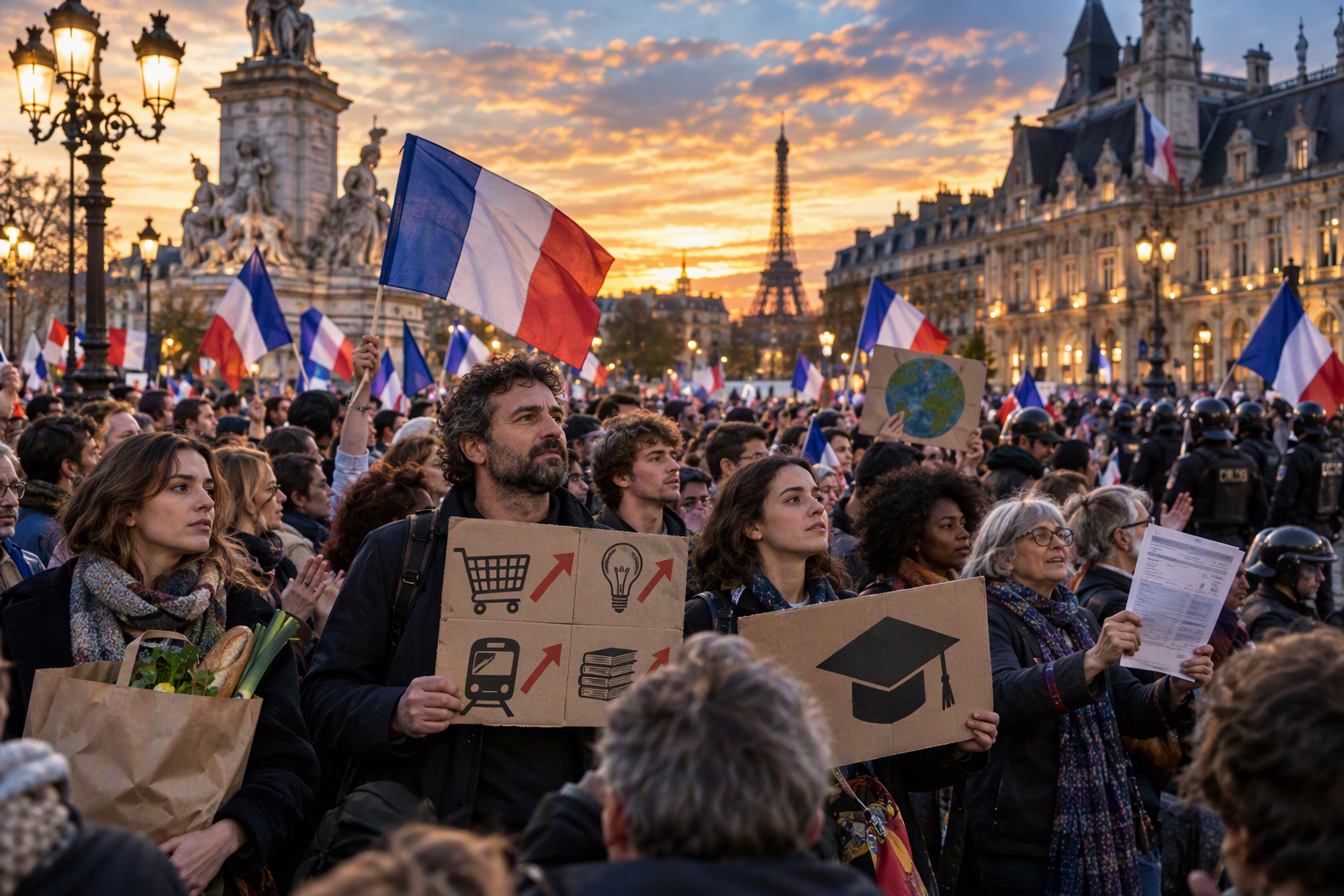
What started as student demonstrations over teacher shortages, overcrowded schools, and deteriorating learning conditions has evolved into something much larger. Workers frustrated by rising prices, families struggling with household budgets, and citizens concerned about the state of public services have joined a movement that reflects deeper anxieties about the country’s future. According to reports, the protests have drawn hundreds of thousands of participants nationwide while also producing some of the most serious public disorder France has experienced in years. [reuters.com], [cbsnews.com]
Today, the French government is attempting to regain control through curfews, enhanced security measures, and increased police deployments. But restoring order on the streets may prove easier than restoring public confidence.
The real challenge facing France is not simply ending the riots. It is addressing the economic and social frustrations that have placed the country in a state of growing tension.
A Crisis Years in the Making
To understand the current movement, it is important to look beyond the immediate headlines.
France has long prided itself on strong public services, accessible education, and an extensive social safety net. Yet over recent years, many citizens have increasingly voiced concerns that these systems are under strain.
Teachers have complained about staffing shortages. Healthcare workers have warned about pressure on hospitals. Local officials have highlighted funding challenges. Families have faced higher costs for housing, transportation, and daily essentials.
Individually, each issue might not have ignited a national movement.
Together, they created a sense that ordinary life was becoming more difficult.
The protests that erupted this autumn appear to have provided an outlet for frustrations that had been building quietly for years.
For many participants, the demonstrations are not simply about one policy or one government decision. They represent a broader concern about living standards, opportunities, and whether the political system is responding effectively to public needs.
Why Students Started Protesting
The movement’s origins can be traced back to schools.
According to reports, students initially took to the streets to protest teacher shortages, overcrowded classrooms, deteriorating facilities, and broader concerns about educational quality. Many argued that learning conditions were worsening at a time when educational success is becoming increasingly important for future economic opportunities. [cbsnews.com], [thedailyjagran.com]
Some students described classrooms filled beyond capacity.
Others complained about ageing infrastructure, maintenance problems, and insufficient support services.
These concerns quickly resonated with parents and teachers who had witnessed similar issues firsthand.
Education has always occupied a central place in French society. As a result, frustrations within schools often carry political significance beyond the classroom itself.
What made the movement especially powerful was that many citizens recognised parallels between educational problems and wider pressures facing public services across the country.
From School Demonstrations to National Unrest
As news coverage expanded, the protests gradually attracted support from groups well beyond the education sector.
Trade unions became increasingly involved.
Workers voiced concerns about wages and cost-of-living pressures.
Families pointed to rising grocery bills and housing expenses.
Public-sector employees highlighted funding shortages affecting public services.
Within weeks, what had begun as a student movement evolved into a much broader expression of social dissatisfaction.
Demonstrators repeatedly raised concerns about the growing gap between household incomes and everyday expenses. While inflation has affected many countries in recent years, many French citizens believe their purchasing power has declined significantly.
The result was a rare moment when multiple grievances converged into a single national conversation.
The Cost-of-Living Issue at the Heart of the Crisis
Perhaps no issue has appeared more frequently throughout the demonstrations than the cost of living.
Whether discussing energy bills, food prices, transportation, or housing costs, many protesters argue that everyday life has become noticeably more expensive.
For younger people, the concern is often linked to future opportunities.
Many students worry about whether they will be able to afford housing after graduation, secure stable employment, or achieve the same standard of living enjoyed by previous generations.
For working families, the pressure can feel immediate.
Budget decisions that once seemed manageable have become increasingly difficult as household expenses absorb larger portions of monthly incomes.
These concerns are not unique to France. Similar debates are taking place throughout Europe and other developed economies. However, in France, where public expectations of government support remain particularly high, economic frustrations often carry significant political implications.
When Demonstrations Turned Violent
Despite the movement’s broader social goals, national attention increasingly shifted toward violence that occurred during some demonstrations.
Authorities reported widespread disorder in several cities, including attacks on businesses, damage to public property, and confrontations between protesters and security forces. Thousands of businesses were reportedly affected during the unrest. [reuters.com], [cbsnews.com]
One of the challenges confronting the government has been separating peaceful demonstrators from those responsible for criminal activity.
Many protesters insist that the violence does not represent the movement’s core objectives.
Government officials have similarly attempted to distinguish between citizens exercising the right to protest and individuals accused of exploiting demonstrations to engage in looting or vandalism. [cbsnews.com], [reuters.com]
Nevertheless, images of burning buildings often dominate international news coverage, making it easier to focus on the symptoms of public anger than its underlying causes.
France Responds With Curfews
Faced with escalating unrest, authorities introduced curfews in parts of several cities.
Areas of Paris, including the well-known districts around Place de la République and Les Halles, became subject to overnight restrictions. Other cities implemented similar measures designed to reduce opportunities for violence and protect businesses and public infrastructure. [reuters.com], [france24.com], [cbsnews.com]
Officials later stated that the curfews contributed to calmer nights in some locations and justified extending the restrictions. Authorities also increased police deployments and announced plans for a substantial security presence at future demonstrations. [cnbc.com], [france24.com]
The measures reflect the government’s immediate priority: restoring public order.
Yet curfews alone cannot answer the questions being raised by protesters.
The Difficult Position Facing Macron
For Emmanuel Macron, the crisis arrives at a politically sensitive moment.
Throughout his presidency, Macron has often positioned himself as a reformer willing to tackle difficult economic and structural challenges. Supporters argue that these reforms are necessary to keep France competitive and financially sustainable.
Critics, however, frequently accuse his administration of being disconnected from everyday concerns.
The current unrest has amplified those criticisms.
On one side, voters expect the government to maintain security and protect communities from violence.
On the other, many citizens want clear action on affordability, education, and public services.
Responding successfully requires balancing both priorities simultaneously.
A heavy security response without meaningful policy solutions risks deepening resentment.
Conversely, appearing too lenient on violence could provoke criticism from citizens demanding stronger law enforcement.
A Familiar Pattern in French History
One reason these protests have attracted so much attention is that they fit into a long tradition of public mobilisation in France.
Historically, some of the country’s most important political and social changes have emerged from protest movements.
More recently, France witnessed the Yellow Vest movement, which began as a reaction to fuel taxes before expanding into a broader debate about inequality, living standards, and political representation.
The current demonstrations differ in several respects, but they reveal a similar reality.
Economic concerns often serve as the spark.
Larger questions about trust, opportunity, and fairness sustain the fire.
In that sense, today’s unrest reflects not only immediate frustrations but also long-standing tensions about how governments should respond when citizens feel left behind.
The Financial Reality Facing the Government
One factor making the situation particularly complex is France’s financial position.
The government faces significant debt and budget pressures at a time when protesters are demanding greater investment in schools, services, and social support programmes. Reports note growing concerns around public debt, government borrowing, and budget deficits. [financialexpress.com]
This creates a difficult policy dilemma.
Investing more money in education and public services could address some public concerns.
However, greater spending may worsen fiscal challenges unless accompanied by difficult financial decisions elsewhere.
Every option carries political risks.
Cut spending and face public anger.
Increase spending and face criticism over debt.
Raise taxes and risk dissatisfaction from households and businesses.
The reality is that many of the solutions being demanded come with significant financial costs.
The Economic Impact of the Riots
While political debates continue, businesses across France are already dealing with the consequences.
According to reports, nearly 3,000 shops and businesses were affected during the period of unrest. [reuters.com]
For business owners, the damage extends beyond broken windows and stolen goods.
Temporary closures mean lost revenue.
Employees may experience reduced working hours.
City centres affected by unrest often see declines in consumer traffic.
Tourism can suffer when visitors become concerned about safety.
Even after physical repairs are completed, economic recovery can take considerably longer.
Small business owners, in particular, often lack the financial reserves necessary to absorb prolonged disruptions.
The Numbers Behind the Unrest
Several figures illustrate the scale of the crisis.
Authorities reported that more than 2,500 people had been taken into police custody following incidents linked to the unrest. [cbsnews.com]
France’s Interior Ministry estimated that approximately 550,000 people participated in demonstrations nationwide, while labour unions suggested even higher numbers. [reuters.com]
These figures highlight an important point.
Although media coverage naturally focuses on violence, the majority of participants were involved in demonstrations rather than riots.
That distinction matters because it suggests widespread public engagement with the issues being raised.
Why Young People Remain Central to the Movement
Perhaps the most significant aspect of the protests is the prominent role played by younger generations.
Students were among the first to speak out.
They remain among the most visible participants.
This is not surprising.
Young people are often among the first to feel the effects of challenges such as housing affordability, educational inequality, and uncertain employment opportunities.
When students raise concerns, they are frequently expressing fears not only about the present but also about the future.
For many young protesters, the demonstrations are ultimately about opportunity.
Will education provide a pathway to success?
Will living standards improve?
Will future generations enjoy greater prosperity than the last?
These questions help explain why the movement has resonated so strongly among younger citizens.
What Happens Next?
France now faces a critical choice.
Security measures may reduce immediate tensions.
Curfews may prevent further unrest.
Police deployments may restore calm to city centres.
Yet those actions alone are unlikely to resolve the concerns that initially brought people into the streets.
Real progress may require broader conversations about education, public services, economic opportunity, and household affordability.
Whether such discussions lead to meaningful reforms remains uncertain.
What is clear is that the events of recent weeks have exposed frustrations that cannot easily be ignored.
Conclusion
The riots that captured global headlines are only one chapter in a much larger story.
At its heart, France’s current unrest is about citizens seeking answers to questions that affect daily life: the quality of schools, the cost of living, the strength of public services, and confidence in political leadership.
Curfews and police patrols may help restore order in the short term.
The bigger challenge lies in restoring trust.
For Emmanuel Macron‘s government, the coming months will test whether it can respond not only to unrest on the streets but also to the frustrations that helped create it. Until those deeper issues are addressed, many observers believe the anger driving the protests is unlikely to disappear entirely.

The PakSoil News Team is a dedicated group of journalists, editors, and analysts committed to delivering accurate, timely, and balanced news coverage. From politics and business to culture and community, we bring you stories that matter — verified, unbiased, and written with integrity.


