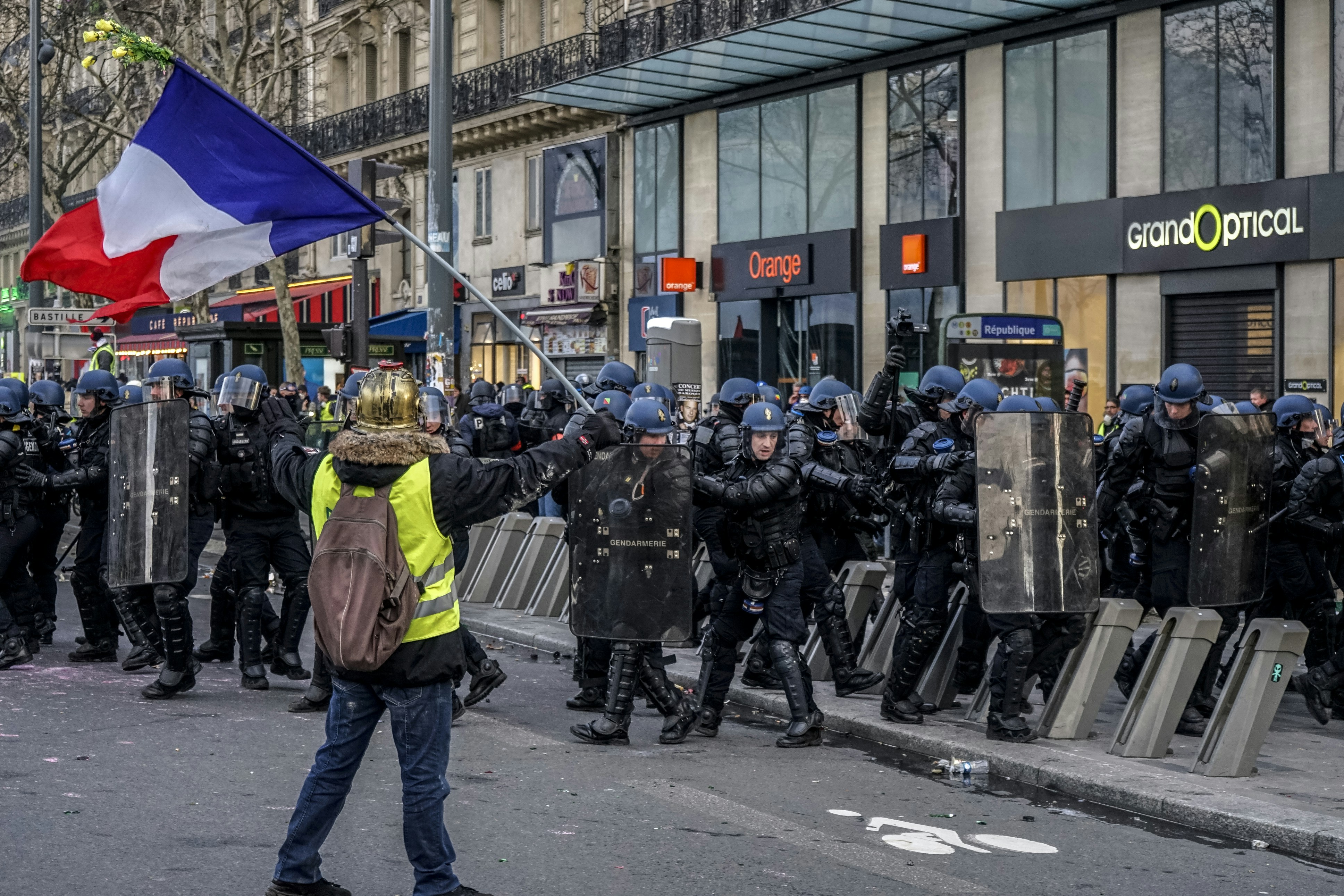
France is preparing for an extensive security operation on Saturday, with the government planning to deploy about 70,000 police officers across the country. The scale of the mobilization reflects concern that demonstrations could again be accompanied by disorder after serious street violence the previous weekend. Authorities are positioning the deployment as a preventive measure, intended to protect the public, limit damage and reduce the risk that tensions will escalate during gatherings.
The operation is nationwide rather than confined to a single city, underscoring the challenge of responding to protests that may take place in multiple locations. Police presence is expected to be visible, while officials seek to maintain order and enable people to assemble. The government’s decision signals that it regards the possibility of further unrest as significant, but the deployment alone cannot determine how events unfold. Crowd dynamics, local conditions and the conduct of demonstrators and security personnel will all shape the outcome.
That leaves a central question for Saturday: can a large-scale security presence keep demonstrations peaceful while preserving the right to protest? A strong deployment may reassure residents and help authorities respond quickly if violence occurs. At the same time, policing must be carried out in a way that supports lawful assembly and avoids turning routine demonstrations into confrontations. The balance will be closely watched across France. The operation therefore has two linked aims: preventing a repeat of the previous weekend’s serious street violence and allowing public expression to continue. Its effectiveness will be measured not only by whether disorder is contained, but also by whether people are able to demonstrate safely and peacefully. As the country braces for the day, officials face the task of preparing for risk without assuming that every gathering will become violent.
The demonstrations at the center of France’s current tensions are linked to the rising cost of living and the pressure households face from higher prices. Participants have taken to the streets to express concerns about purchasing power, economic insecurity and the ability to meet everyday expenses. These issues have prompted public gatherings in several areas, placing economic hardship at the heart of the protests and sharpening debate about how the government should respond.
The demonstrations should be distinguished from acts of violence reported around some events. Many people have joined marches or rallies to make their views heard peacefully; their presence does not mean they were involved in disorder. As with other large public gatherings, the actions of a smaller number of individuals can occur on the edges of a demonstration without representing the intentions or conduct of everyone taking part.
Authorities and news reports have described some of the street violence on the fringes of the protests last weekend as among the worst seen in France in years. The incidents have heightened concern about the potential for further clashes, damage or disruption. At the same time, describing those episodes as part of the broader protest context should not erase the distinction between peaceful participation and violent behavior, or imply that all demonstrators took part.
The reported scale of the disorder has made public order an urgent issue for the government as it prepares for further demonstrations. Officials must consider how to protect people, maintain access to public spaces and respond to violence, while also allowing peaceful assembly. The challenge is particularly significant because the protests reflect persistent cost-of-living concerns as well as immediate security risks. How authorities manage both dimensions may shape public confidence in their response and influence the course of events in the days ahead.
On Friday, Interior Minister Laurent Nunez announced a nationwide deployment of 70,000 police and gendarmes ahead of the expected protests. The scale of the mobilization reflects the government’s concern that demonstrations could lead to disorder, as well as its intention to maintain public safety across the country. Nunez said authorities would adopt a particularly firm approach, emphasizing that security forces were prepared to intervene if events escalated beyond peaceful protest.
Nunez also cautioned against assuming that the expected gathering would be a peaceful, friendly demonstration. That description represented the minister’s assessment of the potential risks, not an established account of every participant or a claim that all demonstrators intended to cause trouble. The distinction matters: large protests can include people with different aims, and the possibility of violence does not define everyone who chooses to take part.
His remarks nevertheless conveyed a clear message about the government’s priorities. By highlighting the possibility of disorder and promising a firm response, Nunez sought to deter acts of violence and signal that attacks, vandalism, or other serious disruption would not be tolerated. The large police presence is intended both to protect people and property and to give authorities the capacity to respond quickly if incidents occur.
The minister’s warning also places responsibility on officials to balance enforcement with the rights of people to assemble and express their views. A firm security posture can reassure communities facing uncertainty, but its implementation will be closely watched, particularly if police confront crowds or make arrests. Nunez’s announcement therefore serves as both a preventive signal to potential troublemakers and a public statement that the state is preparing for a challenging day. It does not establish how the demonstrations will unfold; rather, it sets out the government’s expectations and approach should peaceful protest give way to violence or disorder.
The planned security mobilization is notable not only for its scale but also for the type of personnel expected to take part. Alongside police and other forces assigned to public-order duties, the deployment is set to include elite units ordinarily associated with counter-terrorism operations and hostage rescues. Their reported inclusion marks an unusual feature of the response to anticipated demonstrations and possible unrest.
These specialist teams are trained and equipped for exceptionally high-risk situations. Their routine role differs from the management of ordinary street demonstrations, and their presence should not be taken as evidence that they have been assigned a particular task during the protests. Available reporting describes their inclusion in the broader mobilization, but does not establish how they will be used, where they will be positioned, or whether they will engage directly with demonstrators.
Even without a specified operational role, the decision to include such units carries significance. It signals that authorities are preparing for a range of contingencies and want access to capabilities designed for situations that can develop rapidly or involve serious threats. In that sense, the deployment communicates an elevated level of readiness, while also reflecting official concern about the potential risks surrounding the demonstrations. It does not, by itself, confirm that violence is expected or inevitable.
The presence of elite personnel may also shape public perceptions of the response. Some may see it as a precaution intended to protect the public and enable a rapid response if circumstances deteriorate. Others may regard it as a sign of an unusually forceful posture toward protest activity. The distinction between preparation and operational use is therefore important: the units’ inclusion indicates readiness, not a confirmed plan to deploy them against demonstrators. As events unfold, clarity about their remit will matter to assessing how France balances public safety, protest rights, and proportionate policing.
France’s Interior Minister Laurent Nuñez said social media posts included calls for violence from groups he described as “ultra-left,” as authorities prepared for major demonstrations. His remarks conveyed the government’s assessment of potential risks ahead of the protests; they do not, on their own, establish that every reported post was authentic, represented an organized plan, or reflected the intentions of demonstrators more broadly. The characterization and the claims about online content should therefore remain explicitly attributed to Nuñez unless independently substantiated.
Online messages can nonetheless affect preparations for a large public gathering. Posts that appear to encourage attacks, identify targets, or coordinate confrontations may prompt officials to consider the possibility of violence, adjust policing plans, and monitor developments. Their circulation can also complicate efforts to assess risk, particularly when material is repeated, taken out of context, or difficult to verify. Authorities may have to make decisions before they can establish who created a message, whether it is credible, and whether anyone intends to act on it. These uncertainties can contribute to heightened vigilance, but they are not proof that violence will occur.
At the same time, a clear distinction is essential between threats or incitement and lawful political expression. Criticism of government policy, calls to protest, and forceful political opinions are not equivalent to urging people to commit violence. Treating broad categories of speech or entire protest movements as dangerous risks blurring that boundary and stigmatizing participants who intend to demonstrate peacefully. Any response to online material should be grounded in specific evidence, consistent with legal protections, and focused on credible threats and conduct rather than political viewpoint. Nuñez’s warning thus forms part of the security context, while the underlying claims require careful attribution and should not be generalized to protesters as a whole.
The decision to deploy about 70,000 police officers on Saturday followed a previous weekend in which widespread rioting exposed serious limits in the government’s ability to contain disorder. According to the account provided, officials acknowledged that they had “lost control” as violence spread through streets in multiple locations. That admission marked a stark assessment of the authorities’ response, and it helped frame the next mobilization not as routine crowd management but as an effort to prevent a repeat of events that had overwhelmed existing measures.
The severity of the street violence appears to have been central to the scale of the planned deployment. When unrest escalates beyond isolated confrontations, authorities must manage public gatherings while also responding to damage, protecting residents and businesses, and restoring access to affected areas. The previous Saturday’s disturbances indicated that ordinary policing arrangements had not been sufficient to keep events contained. A much larger presence was therefore intended to provide more personnel across the country and allow security services to respond more quickly if trouble developed again.
The mobilization also included a more specialized security presence, reflecting the expectation that protests could become volatile rather than remain peaceful demonstrations. Specialized units are typically assigned to manage crowd movement and confront serious public-order incidents, giving commanders options beyond standard patrols. Their inclusion suggests that the government was preparing for a range of scenarios, while seeking to deter violence through visible readiness. The deployment cannot by itself guarantee calm, particularly where tensions remain high, but it demonstrates how sharply the government’s posture shifted after its public acknowledgment of losing control. Saturday’s operation was thus shaped by both the scale of the previous weekend’s unrest and the political significance of showing that authorities were better prepared to respond.
The scale and timing of the unrest have caught President Emmanuel Macron’s government off guard, placing it under pressure at a particularly sensitive political moment. France is six months away from a presidential election to choose Macron’s successor, and public attention is already focused on the country’s direction and the government’s record. Protests over the cost of living therefore present more than an immediate challenge to public order: they test the administration’s ability to respond credibly when households are concerned about everyday expenses.
Officials face a difficult balance. They must acknowledge the financial strain driving public anger and show that people’s concerns are being heard, while also preventing demonstrations from escalating into violence or widespread disruption. A response perceived as dismissive could deepen frustration; an approach seen as unable to maintain order could weaken confidence in the state’s capacity to manage a crisis. The large police mobilization reflects the seriousness with which authorities are treating the security risks, but policing alone cannot resolve the economic grievances behind the unrest.
The government’s choices may consequently carry political consequences, regardless of how events develop. Measures to ease pressure on living costs, dialogue with protesters and affected communities, and clear explanations of public-safety decisions will all shape how the response is judged. At the same time, the administration must avoid allowing short-term crisis management to appear detached from the broader concerns facing the country. With the succession vote approaching, perceptions of competence, fairness and responsiveness are likely to matter. That does not determine the election’s outcome, but it makes the handling of the unrest a consequential test of public confidence in government during an already charged period.
Any large-scale security deployment before demonstrations places authorities under competing obligations. They must protect people and property, reduce the likelihood of violence, and preserve the ability to assemble and express dissent peacefully. These aims can reinforce one another: clear routes, accessible emergency services, and proportionate responses may help demonstrators, residents, businesses, and officers remain safer. Yet security decisions also shape the character of a public gathering, making restraint, communication, and transparency important from the outset.
A visible police presence may reassure people concerned about clashes, vandalism, or disruption, particularly when officers are available to assist and explain restrictions. For others, heavily equipped units, barriers, or extensive checks could appear intimidating, even if intended as precautionary measures. Perceptions may vary across neighborhoods and groups, influenced by prior encounters with law enforcement and by how deployment is organized. The number of officers alone therefore cannot determine whether people feel protected; visibility, conduct, and the clarity of instructions may matter just as much. Public confidence can depend on whether rules are applied consistently and whether individuals can understand how to comply.
The risk of escalation is conditional rather than inevitable. Crowded streets, conflicting instructions, isolated acts of aggression, or circulation of unverified reports could heighten tensions. Conversely, trained liaison teams, accessible channels for dialogue, clearly marked protest areas, and separation of peaceful participants from violent conduct may help keep incidents contained. If force is used, its necessity and proportionality may become central to judgment; any injury or disputed account could affect trust beyond the immediate scene. Authorities must balance intervention against the possibility that an overly broad response could deepen confrontation. Organizers and participants influence outcomes through coordination, de-escalation, and respect for safety arrangements, without losing the right to criticize government policy. A large deployment may reassure some members of the public.
Saturday’s demonstrations will be judged not only by their size, but by how events develop across the day. A central indicator will be whether marchers can assemble and voice their concerns peacefully, and whether any disruption remains limited and temporary. The conduct of crowds at gathering points, along routes and near public buildings may help show whether tensions are easing or escalating. Reports of incidents should be distinguished from the wider experience of participants, rather than treated as evidence that every demonstration has become violent.
Another measure will be what happens at the fringes of gatherings. Isolated clashes, property damage or confrontations can create serious risks even when most people protest without incident. The police response will therefore matter: authorities must manage public safety while allowing lawful demonstrations to proceed. The scale, timing and proportionality of interventions, as well as communication between officers and demonstrators, may influence whether local incidents subside or spread. Clear, verified information will be important as accounts emerge, particularly where reports differ about how an encounter began.
The government’s warnings and the planned deployment of about 70,000 police officers and gendarmes are indicators of preparation, not proof of what will happen. Their effectiveness can only be assessed against events on the ground: whether security measures deter disorder, protect the public and avoid contributing to further tension. The reported plan describes the authorities’ response in advance; it does not establish that violence will occur, nor that the measures will prevent it. Saturday’s immediate test is the maintenance of public order. The broader challenge will remain after the demonstrations: addressing cost-of-living grievances in ways that are credible to affected households, while preserving channels for peaceful expression. A response seen as focused solely on containment could deepen distrust, whereas engagement with the pressures behind the protests may help prevent a difficult day from becoming a more prolonged crisis.
Source: https://www.theguardian.com

The PakSoil News Team is a dedicated group of journalists, editors, and analysts committed to delivering accurate, timely, and balanced news coverage. From politics and business to culture and community, we bring you stories that matter — verified, unbiased, and written with integrity.