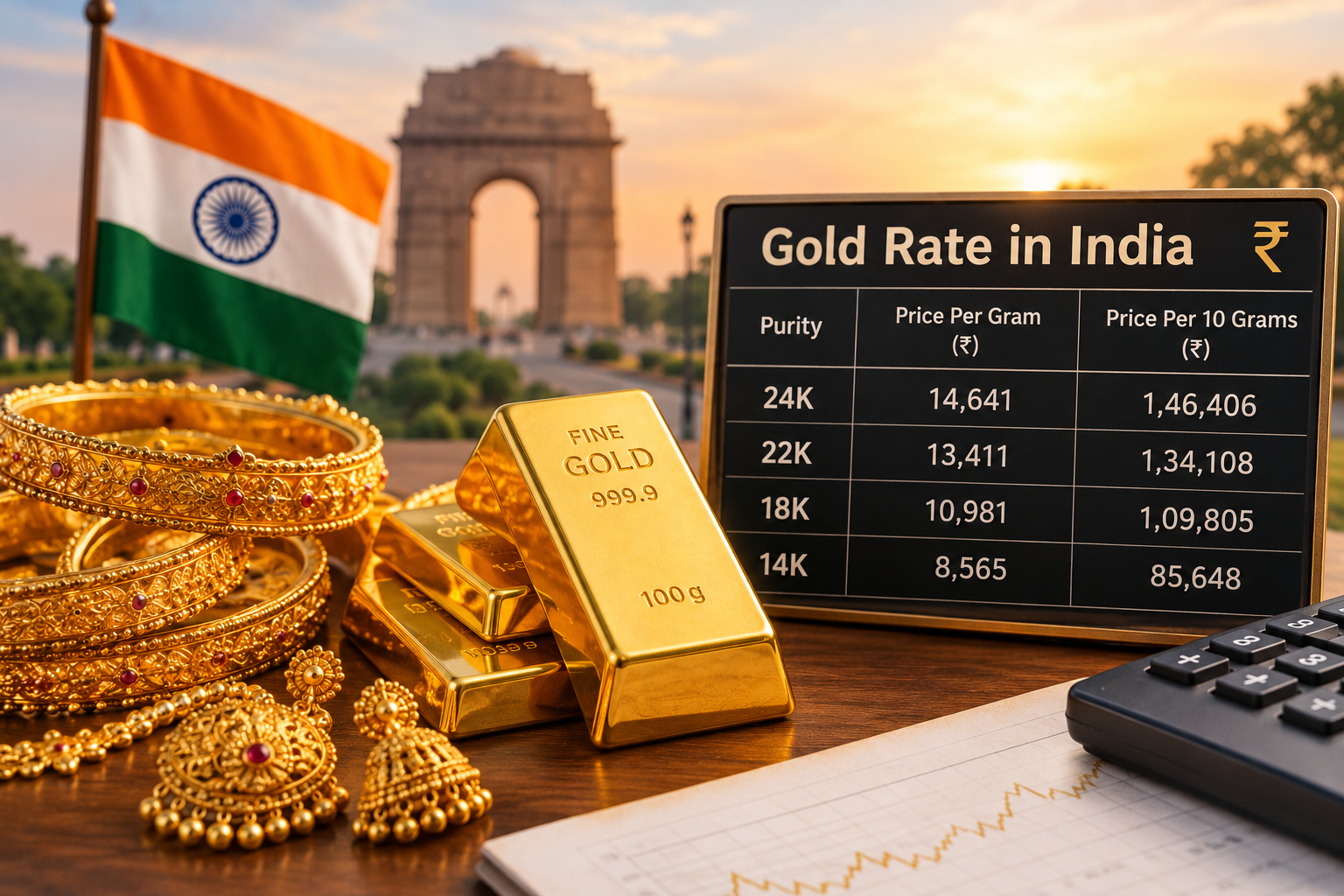
Gold has always had a special place in Indian households. For some people, it is part of a wedding tradition. For others, it is a way of putting money into something tangible that can be held for years. Gold is also widely watched by investors because its price can move significantly when global markets, currencies and economic conditions change.
That is why the gold rate in India is followed closely every day.
As of 19 October 2026, the indicative national gold rate is around ₹1,46,406 per 10 grams for 24K gold and ₹1,34,108 per 10 grams for 22K gold. The corresponding rates are approximately ₹14,641 and ₹13,411 per gram.
These figures are useful as a market reference, but they should not be confused with the final price of jewellery at a shop. Local prices can vary, and jewellery buyers may also have to pay GST, making charges and other costs.
Gold Rate in India Today
Here is a quick look at the indicative gold prices in India on 19 October 2026:
| Gold Purity | Approx. Price Per Gram | Approx. Price Per 10 Grams |
| 24K | ₹14,641 | ₹1,46,406 |
| 22K | ₹13,411 | ₹1,34,108 |
| 18K | ₹10,981 | ₹1,09,805 |
| 14K | ₹8,565 | ₹85,648 |
The figures above are based on the latest available benchmark information. The India Bullion and Jewellers Association (IBJA) publishes benchmark rates at different times, while retail jewellers may quote somewhat different prices.
For example, current city-level quotations can be higher than the national benchmark. On 19 October, one market tracker listed 24K gold around ₹1,47,590 per 10 grams in Delhi and Chennai, while Mumbai was around ₹1,47,440.
This difference is one reason buyers should check the price offered by their local jeweller before making a purchase.
What Is the Price of 24K Gold in India?
24K gold is considered the highest commonly traded purity. It contains approximately 99.9% gold and is generally associated with investment products such as gold bars and coins.
On 19 October 2026, the indicative 24K benchmark was around ₹14,641 per gram, or ₹1,46,406 per 10 grams.
Because 24K gold is relatively soft, it is not always the preferred choice for everyday jewellery. Jewellery manufacturers commonly use lower-purity gold by mixing it with other metals, which makes the finished piece more durable.
What Is the Price of 22K Gold in India?
22K gold contains about 91.6% pure gold and is one of the most common purities used for traditional Indian jewellery.
The indicative 22K rate on 19 October 2026 was around ₹13,411 per gram, or ₹1,34,108 per 10 grams.
If you are shopping for a necklace, bangles, earrings or other traditional jewellery, you will often see 22K gold quoted rather than 24K gold.
However, the gold rate is only one part of the final jewellery bill.
Why Does the Gold Rate Change Every Day?
There is no single reason behind daily movements in gold prices. Several factors work together.
International Gold Prices
Gold is traded internationally, so movements in the global bullion market have a direct influence on prices in India.
On 19 October 2026, international spot gold was around $4,147.87 per ounce, with the market under some pressure from a stronger US dollar and higher US Treasury yields.
When international gold prices rise, Indian prices generally feel the impact as well. The reverse can happen when global gold prices decline.
The Indian Rupee
The rupee also matters because international gold is priced in US dollars.
If the rupee weakens against the dollar, importing gold can become more expensive in rupee terms. This can contribute to higher domestic gold prices even when the international price does not move dramatically.
Interest Rates
Interest rates are another factor that investors watch.
Gold does not pay interest or dividends. When interest rates and bond yields rise, some investors may find interest-bearing investments more attractive.
On the other hand, expectations of lower interest rates can make gold more appealing.
This relationship is not always predictable, but central-bank policy remains an important influence on the global gold market.
Inflation and Economic Uncertainty
Gold is often viewed as a store of value during uncertain periods.
When investors become concerned about inflation, geopolitical tensions or financial instability, demand for gold can increase. Stronger demand can support prices.
India’s long-standing cultural demand for gold also gives the domestic market characteristics that differ from some other countries.
Why Is Gold So Important in India?
Gold is much more than an investment in India.
It is closely associated with weddings, festivals and family traditions. Many households purchase jewellery during important life events and keep gold for generations.
Demand can also become particularly noticeable around major festivals and wedding seasons.
This cultural connection means that gold remains relevant even when financial-market conditions change.
For many families, buying gold is not simply about trying to make a profit. It can also be about tradition, savings and having an asset that can potentially be sold when needed.
24K vs 22K Gold: Which One Is Better?
There is no universal answer because it depends on what you want to do with the gold.
24K gold has higher purity and is generally more suitable for bars, coins and some investment products.
22K gold has lower purity but is harder and more practical for many jewellery designs.
If your primary goal is jewellery, 22K may be more appropriate for traditional pieces.
If your goal is simply to own high-purity physical gold, 24K products may be more relevant.
The most important thing is to know exactly what purity you are buying rather than assuming that every gold item contains the same amount of pure gold.
Why Is the Jewellery Price Higher Than the Gold Rate?
This is one of the most important things for first-time buyers to understand.
Suppose the market rate for 22K gold is ₹13,411 per gram. A jewellery shop will not necessarily sell a 10-gram ornament for exactly ₹1,34,110.
The final bill can include additional costs such as:
- Making charges
- Wastage or other manufacturing-related charges
- GST and applicable taxes
- Stone or gemstone costs
- The jeweller’s margin
- Other product-specific charges
Therefore, comparing jewellery prices only by looking at the gold rate can be misleading.
Two shops may quote the same underlying gold rate but produce different final bills because their making charges and other costs are different.
Gold Rate in Major Indian Cities
Gold rates can vary slightly between cities.
On 19 October 2026, reported 24K rates for 10 grams included approximately ₹1,47,590 in Delhi and Chennai, ₹1,47,440 in Mumbai and Kolkata, and ₹1,47,490 in Bengaluru and Ahmedabad.
These differences are relatively small compared with the overall price of gold, but they can still matter when purchasing larger quantities.
Local jewellers may also update their prices at different times during the day.
What Should You Check Before Buying Gold?
Buying gold is a significant financial decision for many families, so it is worth spending a few minutes checking the details.
Check the Purity
Make sure you know whether you are buying 24K, 22K, 18K or another purity.
For jewellery, look for the appropriate hallmark and purity information.
Check the Weight
The price depends heavily on the weight of the gold. Make sure the weight is clearly shown on the bill.
Ask About Making Charges
Do not be afraid to ask how much of your final bill represents making charges.
A piece that appears inexpensive based on its gold weight can become considerably more expensive once workmanship and other charges are added.
Compare Jewellers
If you are making a large purchase, compare the final bill from more than one jeweller.
The cheapest advertised gold rate does not necessarily mean the cheapest final purchase.
Keep Your Invoice
Always keep the purchase invoice and other relevant documents. They can be useful if you later sell, exchange or insure the jewellery.
Is Gold a Good Investment in India?
Gold can play a role in a diversified financial plan, but it should not automatically be treated as a guaranteed investment.
Prices can rise and fall, sometimes quite sharply.
Physical jewellery also has a drawback: the money spent on making charges and other costs may not be recovered when the item is sold.
For people interested primarily in investment rather than jewellery, there are different ways to gain exposure to gold, including physical gold, gold ETFs and other regulated investment products. Each option has its own costs, risks and tax considerations.
The right choice depends on the individual’s financial goals and circumstances.
What Could Happen to Gold Prices Next?
Nobody can reliably predict the exact gold price for the coming weeks or months.
The outlook will depend on several factors, including global interest rates, the US dollar, inflation, geopolitical developments, central-bank policies and demand from major gold-consuming countries.
For Indian buyers, the rupee-dollar exchange rate is particularly important because it can influence the domestic price of imported gold.
The best approach is therefore to look at the broader market rather than relying on a single gold-price prediction.
Final Thoughts
Gold continues to be one of the most closely followed commodities in India, and its importance extends well beyond investment. For millions of households, it is connected with weddings, festivals, family savings and long-term wealth.
As of 19 October 2026, the indicative national benchmark is around ₹1,46,406 per 10 grams for 24K gold and ₹1,34,108 per 10 grams for 22K gold.
However, the actual amount you pay at a jewellery shop can be different. City, jeweller, timing, taxes, making charges and the design of the jewellery can all affect the final price.
If you are planning to buy gold, don’t look only at today’s headline rate. Check the purity, weight, making charges and complete bill before making your decision.
And because gold prices can change quickly, always verify the latest rate with a reliable bullion reference or your local jeweller before completing a transaction.

The PakSoil News Team is a dedicated group of journalists, editors, and analysts committed to delivering accurate, timely, and balanced news coverage. From politics and business to culture and community, we bring you stories that matter — verified, unbiased, and written with integrity.